The Invisible Drift: How Our Bodies Mislead Us in the Saddle
One of the most humbling discoveries in my classical riding
journey was realising just how unreliable my own sense of
straightness could be.
(A lesson I learned riding with Nuno)
One of the most humbling discoveries in my classical riding journey was realising just how unreliable my own sense of straightness could be.
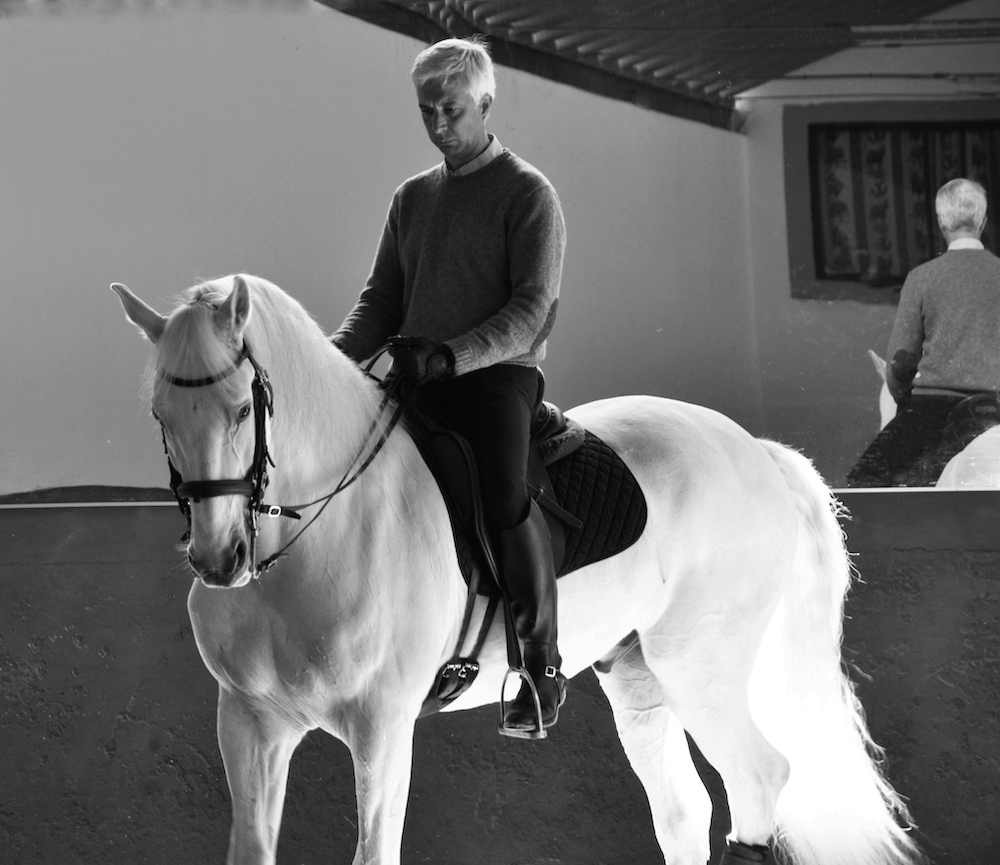
There were countless times when I’d be working through a lateral movement and Nuno would quietly say:
“You’re leaning.”
“You’re off centre.”
“Your hand is drifting back.”
And every time, my first instinct was: No, I’m not. I’m straight. I can feel it. Except I couldn’t
The video told the truth.
Nuno told the truth.
My body did not.
It was a strange and uncomfortable realisation — to understand that I could be doing something clearly visible from the outside, and yet feel absolutely none of it from the inside.
One day, Nuno explained it with an analogy I’ve remembered ever since:
“Think of when you drive a car. Sometimes you arrive at your
destination with no memory of the journey. Riding becomes automatic
in the same way.”
Our bodies slip into what they know. We ride from habit, not always from awareness. And this shows up constantly in the arena.
A rider listens.
A correction makes perfect sense.
They nod, they agree, they understand.
Then they set off again…
…and the old pattern immediately returns.
Not because they aren’t trying.
Not because they’re ignoring the guidance.
But because the mind drops back into its familiar script, and the body simply follows.
For riders who often train alone — and many of us do — this effect is even more pronounced.
Without mirrors, without another eye on the ground, without someone who sees the things we cannot feel, our horses quietly adapt to our asymmetry.
They learn to carry what we cannot yet correct.
Horses are generous like that.
But perhaps the most challenging part of all is this: When you correct something you couldn’t feel, the correction will feel wrong.
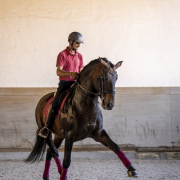
When Nuno said I was leaning forward, and I lifted myself into the correct alignment, it felt as if I was leaning back.
When I brought my hand into a neutral, steady position, it felt as if I was pushing it too far forward.
When I straightened through my body, it felt unbalanced — even insecure.

Because when your “normal” has shifted, truth feels foreign.
This is why classical riding is as much about awareness as it is about technique.
To change how you sit, you must first change how you feel.
To change how you move, you must first notice when you are not aware.
To ride in alignment, you must accept the discomfort of a new baseline.
Nuno helped me understand this in a way that reshaped my entire approach:
Alignment isn’t a posture.
It’s a presence.
A returning.
A quiet recalibration. It is the willingness to meet the truth of your body — even when your body disagrees.
And slowly, as awareness grows, the “wrong” begins to feel right.
The unfamiliar becomes natural.
The body remembers a better way.
Your horse feels it too!
by Teresa Burton founder Lusitano Heritage
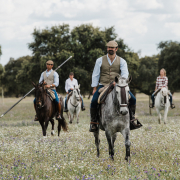
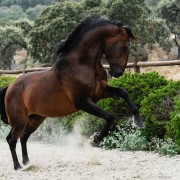
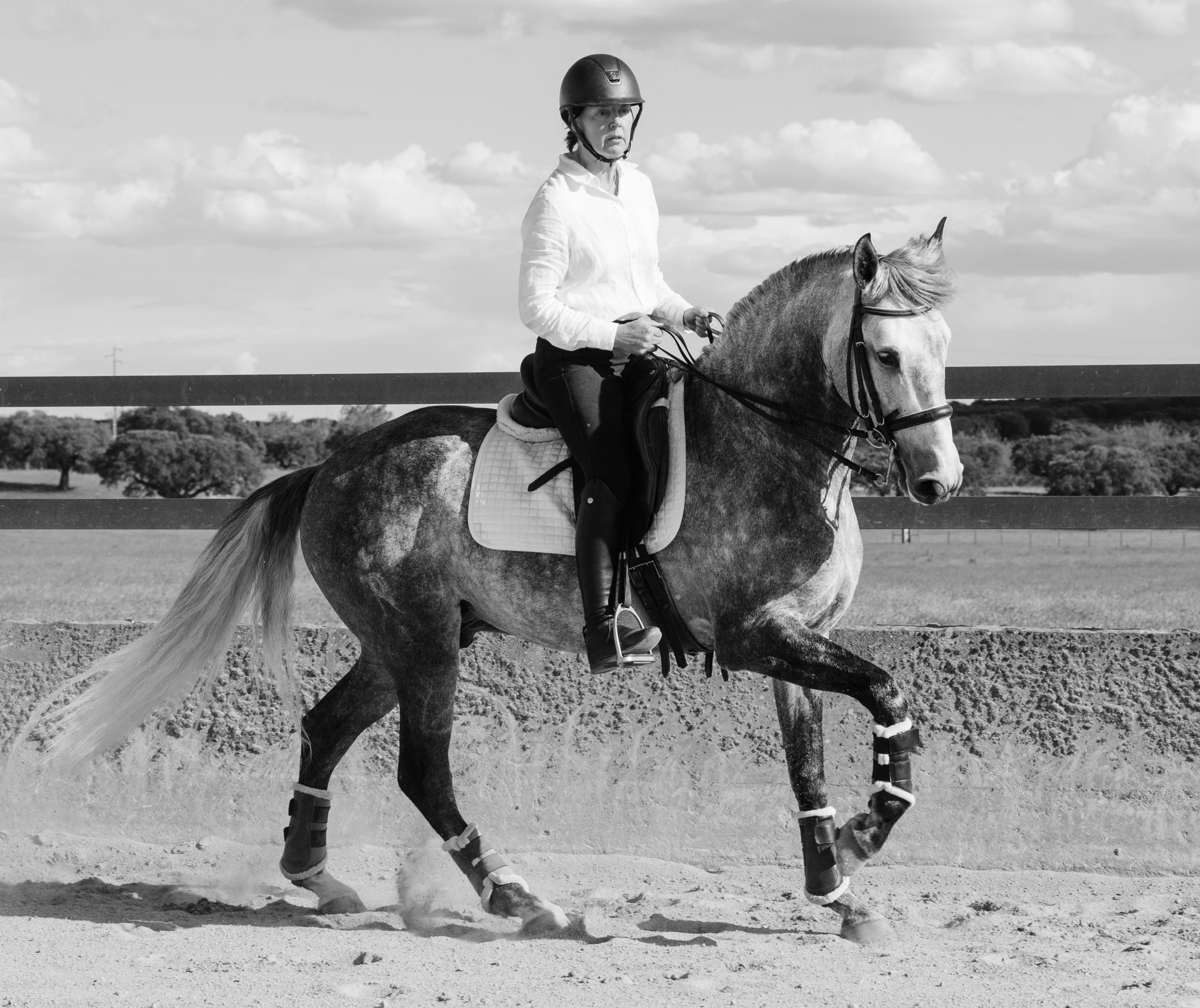
Imagines Teresa on Lidador and Teresa on Nobre by Lena saugen Photography
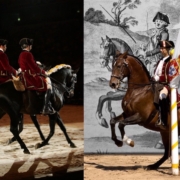
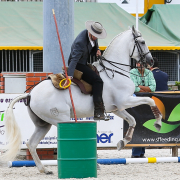
Nuno on Haagan Daz by Bruno Barata Photography
Check out our articles on mindfulness in Riding the Classical Way